
Nothing worth eating
should end up on the compost heap.
When we press our microgreens for Big Shot, what comes out of the press is liquid. What stays behind is the plant — dense, fibrous, and far too good to throw away. So we stopped throwing it away.
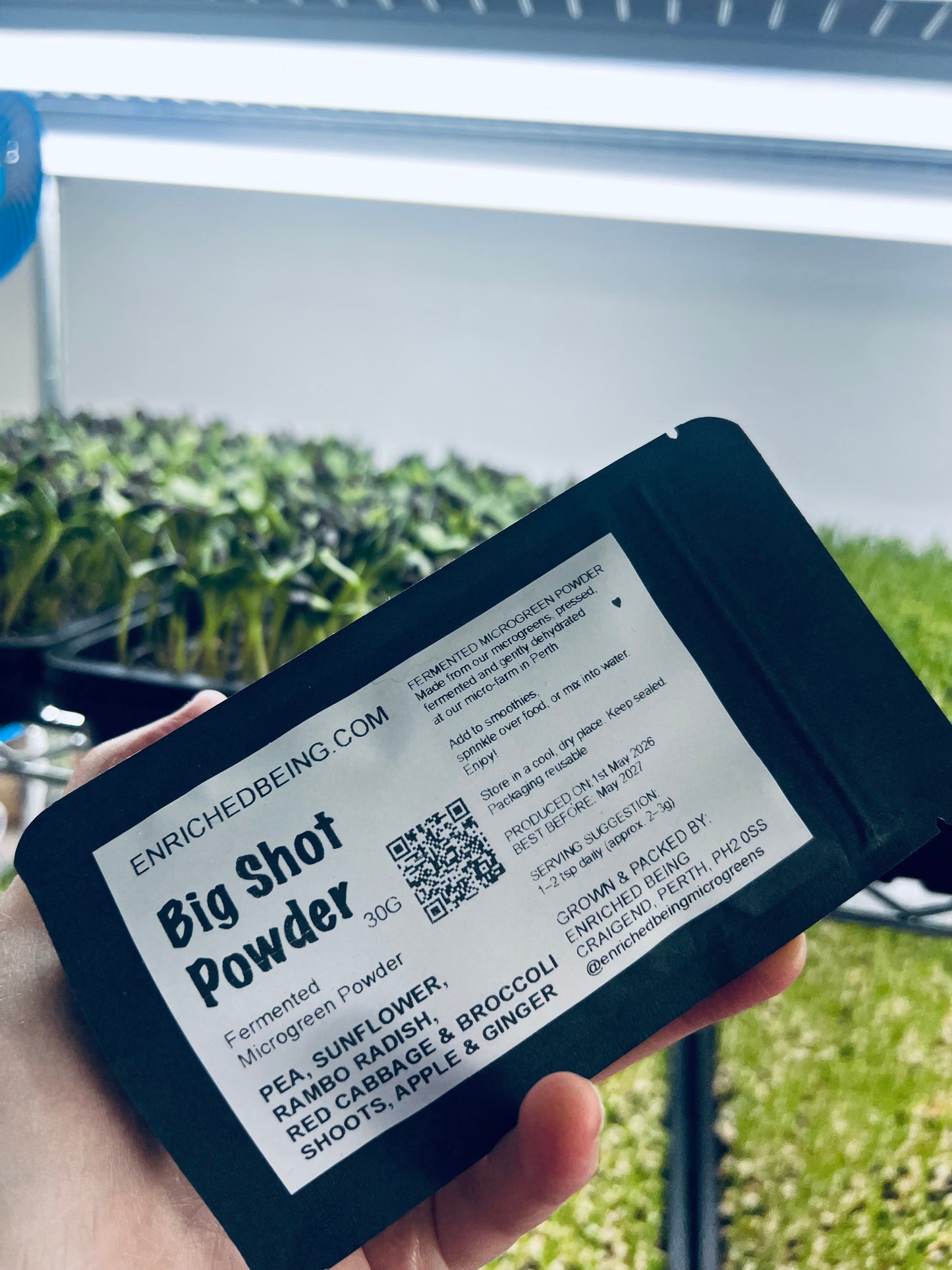
The pulp gets its own ferment in a Blackthorn sea salt brine, then dries at 40 degrees and mills to a fine powder. Because the apple and ginger go through the press with the greens, it works as happily over eggs as it does in a smoothie. Shelf stable, cupboard-friendly, and small enough to live in a suitcase.
Half a teaspoon,
into whatever you're having.
Five microgreens,
each doing a job.
All five grown by us in Perthshire, pressed with apple for balance and ginger for warmth, then fermented in a Blackthorn sea salt brine — hand-harvested on the Ayrshire coast by a producer small enough that we know them by name. That is the whole list. No fillers, no bulking agents, no maltodextrin, no artificial anything.
Pressed, brined,
dried, milled.
This product exists because of what was left in the press. Here is the full journey from tray to pouch.
Why microgreens, and why so gently?
Before you
order.
Is this just the leftovers from Big Shot?
It starts as the pulp from pressing, yes — and we would rather say so plainly than dress it up. But calling it leftovers undersells what it is. Pressing removes liquid; it does not remove the plant. What is left is the fibrous, whole-food part of five microgreens, and it then gets its own ferment in a salt brine before drying.
We built this product because putting that on the compost heap felt indefensible. It is a different thing from Big Shot, not a lesser one.
What can I put it in?
More or less anything, which is the part people are usually surprised by. Because the apple and ginger go through the press with the greens, it works sweet and savoury equally well — as good sprinkled over scrambled eggs or avocado toast as it is stirred into a smoothie, yoghurt or overnight oats. It also disappears nicely into a salad dressing or a bowl of soup.
The only rule is to keep it off direct heat.
How is it different from Big Shot?
Big Shot is the pressed liquid — fermented with lemon and apple cider vinegar, kept chilled, four weeks of life, drunk neat in one go. The Powder is the fibrous part, brine-fermented and dried, shelf stable for the long haul and stirred into whatever you are already eating.
Most people who use both keep the shots for home and the pouch for travelling.
How much should I use?
Two to three grams a serving — roughly a heaped half teaspoon. A 30g pouch works out at ten to fifteen servings. There is no benefit to piling it in; consistency does more than quantity.
What does it taste like?
Deeply green and savoury, with warmth from the ginger and a little sweetness and tang from the apple and the ferment. It is not a sweet powder, but it is not harshly grassy either — which is why it crosses over between breakfast bowls and savoury plates. In a fruit smoothie you will barely notice it; over eggs you certainly will, in a good way. Start with two grams and find your level.
Can I cook with it?
You can, but we would rather you did not. We dry at 40 degrees specifically to avoid the heat damage that degrades vitamin C and sulforaphane — stirring it into something boiling rather defeats the exercise. Add it to cold or warm food, or at the very end of cooking.
Is it suitable if I'm pregnant, breastfeeding or on medication?
It is a fermented raw food product. If you are pregnant, breastfeeding, immunocompromised or taking medication, please check with your GP or midwife before adding it. We would rather you asked.